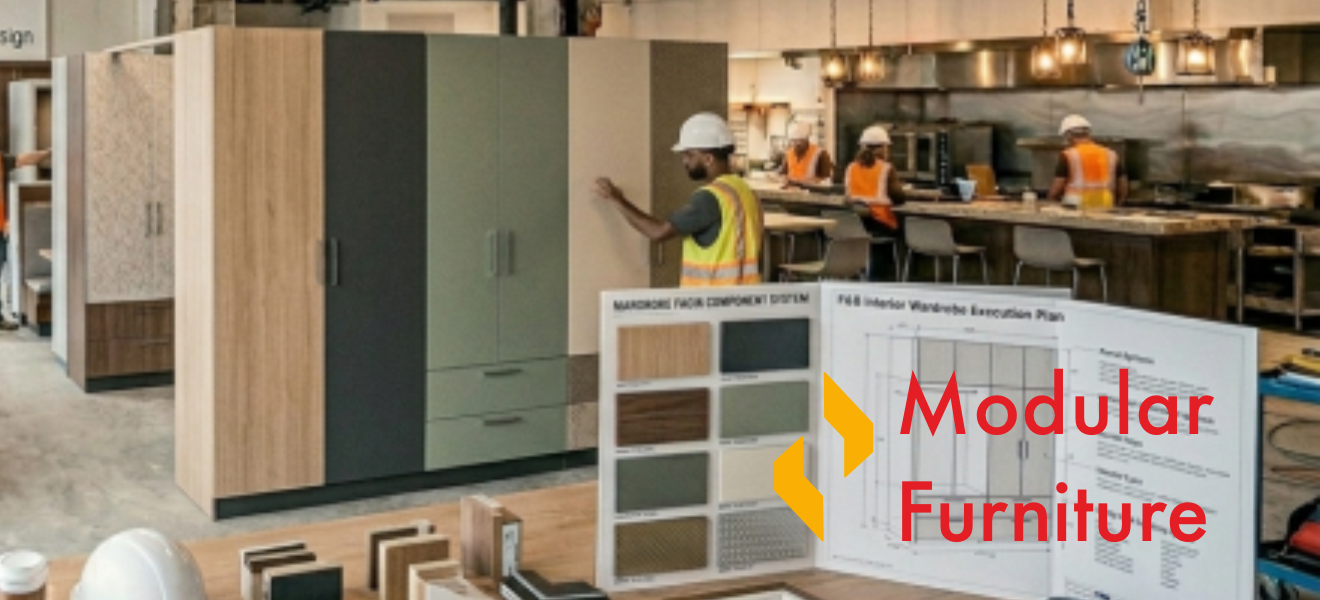
In our interior fit out and furniture projects, we regularly see how modular planning can reduce on site fabrication, simplify installation and make future modifications easier. Modular furniture is no longer limited to premium interiors; it is now a practical solution for homes, offices and commercial spaces.
Let's break this down into simple terms:
Standard Sizes Make a Big Difference
In modular furniture, everything is designed in fixed sizes, like:
- 300 mm
- 600 mm
- 900 mm
or sometimes:
- 200 mm
- 400 mm
- 600 mm
Because of these standard sizes,
the cutting of boards becomes very efficient. This helps in reducing material
wastage.
In normal carpentry work, a lot of board pieces get wasted due to
random sizes. But in modular furniture, everything is planned properly.
- Less trash
- More control over costs
- Clean & neat finish
Modular Furniture vs Carpenter Made Furniture
Modular furniture and carpenter made furniture can both work well, but they are suited to different project requirements. Modular furniture is manufactured using standardized components, which makes production, quality control and installation more predictable. It is particularly useful when the design needs to be repeated across multiple rooms, offices or commercial locations.
Carpenter made furniture can be a better choice when the space has unusual dimensions, complex shapes or highly customized design requirements. In such cases, furniture can be built directly around the site conditions.
The right choice depends on the space, design, quantity, timeline and level of customization required. In many interior projects, a combination of modular and custom built furniture can provide the most practical result.
Simple to switch out or replace
One of the best things about
modular furniture is that it can be changed.
If one unit breaks or you want to
change the design, you don't have to take down the whole thing.
You can:
- Replace only one unit
- Add a new unit
- Easily change the layout
This saves time, money and
effort.
In office spaces, this is very useful because layout changes happen
frequently.
Where Modular Furniture Works Best
Modular furniture works particularly well in spaces where storage, organization and repeatable layouts are important. It can be used in both residential and commercial interiors, depending on the design and functional requirements.
Common applications include:
- Home kitchens and wardrobes
- Office workstations and storage
- Retail counters and display units
- Commercial storage areas
- Reception and utility furniture
- Multi location retail and office projects
For commercial interiors, modular systems can be especially useful when the same furniture design needs to be implemented across multiple locations while maintaining a consistent appearance.
Faster Installation
Modular furniture can be installed faster because most components are manufactured and prepared in a controlled factory environment before reaching the site.
Because of this:
- Work at the site becomes faster
- Less on site cutting, dust and construction mess.
- Proper finishing is maintained
Compared to traditional carpentry, installation time is much less.
Materials Used in Modular Furniture
The performance and appearance of modular furniture depend heavily on the materials selected for the project. Different spaces may require different board types, surface finishes and hardware depending on usage, moisture exposure and design requirements.
Common materials and components used in modular furniture include:
- Particle board and MDF for suitable furniture applications
- Plywood where greater strength or moisture resistance is required
- Laminates and other surface finishes for appearance and durability
- Edge banding for protecting exposed board edges
- Hinges, channels and drawer hardware for functional movement
Material selection should be based on the intended use rather than choosing the same specification for every project. Kitchens, offices, wardrobes and commercial furniture can have different performance requirements.
What is a filler in modular furniture?
In modular furniture, "filler" is a very common word.
Simple meaning:
It is a small piece used to fill
the gap between the modular unit and the wall.
In real sites, walls are never
perfectly straight or in line. So small gaps always remain.
Instead of forcing
the unit or leaving the gap open, filler is used.
For example, a wall may measure slightly differently at the floor, middle and ceiling because of construction tolerances. During site measurement, these variations are checked before the modular units are finalized. The filler width can then be planned to accommodate the actual site condition and maintain a clean alignment.
Benefits of filler:
- Proper fitting of furniture
- Clean finish look
- No visible gaps
- Better stability
Without filler, furniture may look incomplete or misaligned.
Clean Look and Better Planning
Because modular furniture follows standardized sizes and systems, the overall space looks more organized and professional.
- More organized
- More professional
- Easy to maintain
Whether it is a home kitchen, wardrobe, office workstation or storage unit, modular design gives a better finish compared to random carpentry work.
What Affects the Cost of Modular Furniture?
The cost of modular furniture depends on more than just the size of the unit. The materials, finishes, hardware, storage requirements and level of customization can all affect the final project cost.
Important cost factors include:
- Type and thickness of boards used
- Surface finish and laminate selection
- Hardware and fittings
- Number and type of drawers, shutters and storage units
- Customization and site specific requirements
- Transportation and installation requirements
For this reason, comparing modular furniture only on the initial price can be misleading. A better comparison considers the material specification, hardware, finish, installation and expected usage of the furniture.
How We Approach Modular Furniture in Interior Projects
In our interior projects at Next BC, modular furniture is planned around the requirements of the space, available dimensions and intended usage. Before production, site measurements are reviewed so that the furniture can be manufactured with the required dimensions and installation conditions in mind.
For commercial interiors, this approach becomes even more important because furniture may need to work alongside lighting, electrical services, MEP systems and visual merchandising. Coordinating these elements during planning helps reduce avoidable changes during installation.
Conclusion
Modular furniture is not a luxury anymore.
It is a smart and useful answer for today's world.
It helps in:
- Saving material
- Easy maintenance
- Quick changes
- Better finish
That is why more people are now choosing modular furniture for both home and office.
We offer design / turnkey execution with lighting, MEP and visual merchandising integration for your space. Visit www.nextbc.in to learn more . . .
Thanks
Frequently Asked Questions
Modular furniture is furniture that is made up of smaller parts that can be put together in different ways. in standard sized pieces that are easy to put together, take apart or replace when needed.
Because it is made in fixed sizes like 300 mm or 600 mm, cutting of boards is optimized and very little material gets wasted.
Yes, that is the biggest benefit. You can replace or add only the required unit without disturbing the full setup.
Filler is a small piece that goes between furniture and the wall to make sure everything fits right and looks good.
At first, it may seem a little more expensive, but in the long run, it saves money because it doesn't waste as much and is easy to take care of.
Yes, it's great for offices because you can easily change the layout without a lot of work.
For flexibility, finish and speed, modular furniture is generally better. Carpenter work may suit custom one time designs but is less flexible.
Our Related News

Choosing Aesthetics Over Functionality: A Design Dilemma for Homeowners
When designing your dream home, it’s tempting to prioritize beautiful aesthetics sleek countertops, statement lighting...

Ignoring Natural Lighting: A Common Oversight in Home Design
When designing a home, every decision from color palettes to materials contributes to the space's...
Why the Liquor Store Layout Impacts Customer Flow & Billing Speed
See how smarter aisle planning and checkout zoning reduce queues while lifting add on sales.
How a Well Designed Interior Increases Liquor Store Sales
Layout, adjacencies and lighting tweaks that raise basket size in specialty retail.