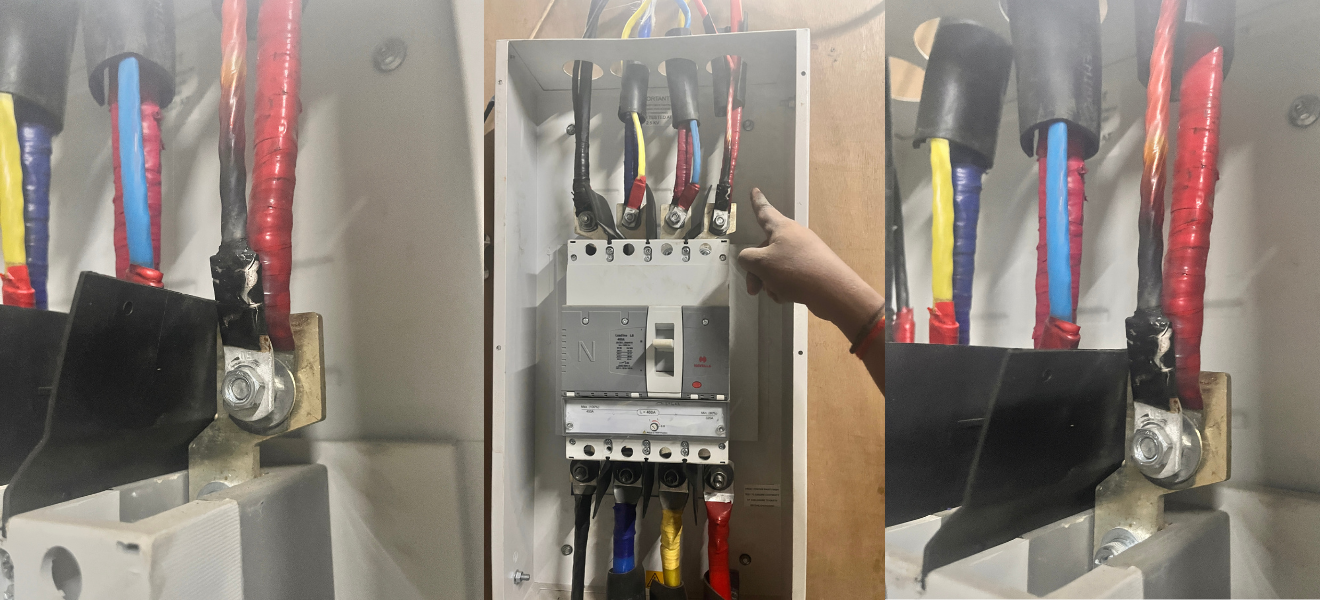
TPN MCCBs and switchgear are often put inside undersized panel boxes in electrical installations because they are hard to find or because of site pressure. Even though it seems easy, this is a common cause of cable overheating and fires.
The image above clearly shows melted cable insulation which is a serious warning sign.
The real issue is not the TPN itself, but rather the size of the box
A TPN MCCB is designed to handle high current, but it also produces heat during operation.
If the outer panel box is too small, several safety issues arise.
Common problems caused by undersized TPN enclosures:
- Sharp bending of heavy power cables
- No clearance between phases
- Poor ventilation and trapped heat
- Stress on cable lugs and terminals
- Difficulty in proper torque tightening
- No space for thermal expansion
Over time, this leads to terminal overheating, insulation breakdown, and finally cable melting or fire.
When cables are forced into a small enclosure:
- Tight bends increase electrical resistance.
- It is not possible for heat to escape properly.
- When they are under load, terminals get hot.
- Insulation becomes brittle
- Finally, insulation melts or burns.
This is exactly what is visible in the image.
A Very Common Site Mistake
In many projects:
- The correct TPN rating is selected
- But the matching enclosure size is not available.
- Contractors install the TPN in a smaller box to save time.
- The panel looks “fitted” but is unsafe internally.
This practice is dangerous and unacceptable.
Correct Practice for TPN Installation
To avoid electrical failures and fire hazards:
- ✔ Always select the panel box size based on TPN rating & cable size
- ✔ Maintain proper cable bending radius
- ✔ Ensure enough free space for heat dissipation
- ✔ Provide adequate ventilation inside the enclosure
- ✔ Allow space for safe termination and maintenance
- ✔ Never compromise due to delivery pressure or availability
1. Verify the facts: Is what you said accurate?
What you said (in simpler words):
"Putting TPN in a smaller box could cause the wires to melt and start a fire."
✔ What is CORRECT
- TPN boxes that are too small do make fires more likely.
- Too much bending on cables makes them too hot.
- The temperature goes up when the air doesn't move around well.
- Terminals heat up when cables are mechanically stressed.
- Fire incidents do happen due to compact enclosures.
❌ What needs to be fixed
- The box size is not the only reason wires don't melt.
- The main reasons are the following:
- Too tight of a bend in the cable
- Not good at getting rid of heat
- Not enough airflow
- Stress on terminals and lugs
- Hard to tighten the torque
- No room for thermal expansion
✔ correct technical statement
A smaller TPN box indirectly causes cables to overheat and melt because it doesn't have enough space to bend, doesn't let air flow freely, and traps heat. It's not just because the box is small.
2 Fixed Technical Explanation
When you put a high-capacity TPN inside a small box, the cables that come in and go out are the following:
- Bend sharply.
- Pushed against metal surfaces
- There are many people near the terminals.
- Not able to let go of heat
This leads to:
- Resistance has gone up.
- Heating the terminal
- Damage to the insulation
- Cable melting
- Risk of fire
Yes, your warning is right, but you need to make it clear.
Be Patient – Safety Comes First
Electrical panels are not decorative items.
If the right size TPN box is not available it is always better to wait than to install it in a smaller enclosure.
A few days of delay are far safer than a lifetime fire risk.
We offer design / turnkey execution with lighting, MEP and visual merchandising integration for your space. Visit www.nextbc.in to learn more . . .
Thanks


Frequently Asked
Questions
High-rise projects in North India are often delayed due to poor coordination between stakeholders, frequent design changes, approval delays, and lack of clear accountability. When multiple teams work without centralized control, execution becomes inefficient and timelines are affected.
These are common reasons mentioned officially, but not the real root cause. The deeper problem is the working mindset. Teams' lack of coordination and unclear accountability cause projects to stall even after approvals and funds are available.
Not completely.
A developer handling a 5–10 acre housing project has already
spent years building credibility. No developer wants to lose
reputation.
However, when multiple agencies collaborate on a project, the
developer often finds themselves at the forefront, even if
others are causing the delay.
High-rise projects are harder to manage due to the involvement of many stakeholders, tight coordination requirements, and multiple dependencies between tasks. Even small delays in one stage can impact the entire project timeline.
Not always.
Buying tiles, wires, or fittings directly from factories may
look cost-saving on paper, but it often disturbs workflow.
Material arrives before the team is ready, storage becomes a
problem, and project sequencing gets affected.
Once the execution process begins, everything transforms into drawings, bills, meetings, and targets. People forget that behind every flat, a family is waiting for safety, comfort, and peace of mind. When emotion disappears from the process, quality and timelines suffer.
This is the typical cycle: Architect says, “PMC will guide.” PMC says, “The consultant will decide.” Contractor says, “We only follow the drawing.” Slowly the project enters a grey zone where no one answers properly, and delays become normal.
Our Related News

Choosing Aesthetics Over Functionality: A Design Dilemma for Homeowners
When designing your dream home, it’s tempting to prioritize beautiful aesthetics—sleek countertops, statement lighting...

Ignoring Natural Lighting: A Common Oversight in Home Design
When designing a home, every decision—from color palettes to materials—contributes to the space's...